We sit around and talk about some recent surrenders and the people who surrendered their pets to the shelter. We paint the owners either black or white because it's easier that way.
There are the necessary surrenders, the ones which were necessitated by concerns for the health and safety of the humans and/or dogs involved and you can't really fault anyone for that.
And then there are the convenience surrenders. We go over the list of excuses.
We're moving.
We've got no time.
We're getting divorced.
We're getting married.
We're getting divorced again.
The dog sheds too much.
The dog pulls too much.
The dog doesn't listen.
The dog scratches the floors.
We didn't know the Old English Bulldog was going to cost so much money to raise.
We didn't know the Great Dane was going to grow so big.
We didn't know the Border Collie would have so much energy.
All those excuses from people too oblivious to even feel the least amount of guilt over the abandonment of their dogs.
Some people who might be more inclined to feel guilt or want to avoid censure when they surrender their dogs, often just lie about their situation. The easiest lie is to say the dog isn't theirs and they just found it. We know these lies happen a lot because there are computers and microchips and vets' records and all that CSI stuff and background checks are pretty easy to do. Like the person who turned in a "found" dog a couple of weeks ago and when TAS brought it to the vet clinic for a health check, the vet was like, "Hey I know that dog," and it turned out the vet knew the owner who happened to be the person who dumped the dog at the shelter.
What a douche.
But then I hear about something like this (Ditching of dog in Milton schoolyard was caught by security camera):
Footage from security cameras at J.M. Denyes Public School shows a car pull up near a fenced-in play area, a passenger get out of the car carrying a dog, and drop him four feet over the side of the fence, says humane society spokeswoman Brenda Dushko.
That was on Feb. 24., a rainy, snowy, and blustery night, with temperatures below freezing, according to Environment Canada historic data. Winds were gusting up to 65 kilometres per hour.
“He was left there basically in the cold to die. There was no way he would have survived the night,” Dushko said. The dog, a white, year-old male boxer had been seriously neglected, with a fractured hip that had never been treated. He also had a skin condition and two different infections that caused him to lose more than 85 per cent of his fur. He was in “terrible shape” and required emergency vet care.
Suddenly, all those people who brought their unwanted dogs to the shelter, even with all their stupid excuses, aren't so bad.
It's easy to paint people in black or white but we're really all splashed with grey.
We pay the puppy miller $50 to rescue the old breeding dog who has never seen the sun.
We are courteous with the owners who are giving us their dog because they are going on vacation and don't want to pay for boarding.
We smile at the hoarder for letting us take a couple of his shit-caked, semi-feral pups.
We shake hands with the devil so sick dogs don't get dumped in the middle of a winter's night into a schoolyard and left to die.


This poodley dog is more like a bunny who barks but don't tell him that. Wouldn't want to give him a complex or anything. Not that there's anything wrong with being a bunny. Of course if he were a bunny, he'd be chubbier and warm enough outside that I wouldn't have to put a fake woolly coat on him to take him for a walk.
This is totally a guy thing but walking a cutesy little dog in a precious little coat makes most guys feel uncomfortable, especially in a crowd of rowdy hockey fans who just happened to be in the vicinity, and so to compensate I had to talk louder, and in a deeper voice, about manly things like fixing cars and chopping wood. Err, perhaps I'm the one with a complex.


The best way to check on the adoption status of this dog (and other dogs and cats and other small domestic animals) is to visit Toronto Animal Services adoption website or call 416 338 6668 for the Toronto Animal Services South shelter. If the dog is no longer on the TAS adoption website, it's probably because it's been adopted already.
A few people have been asking for some tips on taking dog photos so here are some tips. These aren't going to be detailed instructions on how to use your camera or how to use Photoshop. You can probably find that kind of useful information online on real photography how-to sites or you can go to school for three or four or ten years and get a degree in it or whatever it is they do these days.
The pointers here are specifically geared to taking photos of shelter dogs for their adoption website pictures. You can try these strategies out on other subjects, of course, but if you do and then you post those photos of, say, your new baby up on Facebook and strangers start contacting you about when it'll be available for adoption, don't blame me.
I try to get a decent image in as little time as possible because:
1. I'm lazy
2. There are usually lots of dogs to get through
3. It can get really cold in the winter
4. It can get really hot in the summer
5. It can get really wet in the spring and fall
6. For the most part, the dogs would rather be walking and sniffing than staring at a camera so I try to accommodate that as much as I can with the time I have
But even though I'm a lazy photographer, I usually give myself about 30 - 45 minutes for each dog (this includes time just walking or hanging out) so that means if there are several dogs which need pictures, I'm at TAS for a good part of the afternoon. Plus, on top of that, I spend about an equal amount of time editing and processing the photos for each dog. So, that's a minimum of an hour per dog. You're own results will vary, of course, but this will give you some reference point.
I generally want adoption pictures to be clear, to show the dog in a flattering but realistic light, to express some aspect of the dog's personality and to establish an emotional connection with the potential adopter. To do this, I try to take about 100,000 pictures of each dog and pray to God that one or two of them turn out. An infinite number of monkeys, etc. Now, 100,000 pictures takes a bit of time so barring that, here are some other ideas:
1. Try to get the dog comfortable with you before you start taking photos. Some dogs, like some people, are natural hams and you can just start snapping away at them but I find those to be the exception. Most dogs are a little unsure of that camera thingy you've got in your hands which looks like a big evil, alien eyeball and some dogs are extremely nervous having a camera pointed at them. If the dog doesn't know you at all and doesn't know if you might want to eat it for supper, it just exacerbates the camera anxiety problem and you may end up with a lot of shots like this:

Or this:

So, before you even take the camera out, spend some time with your model. Get to know the subject a bit. Take it for a walk. Sit down with it. Reassure it that it's not fat, that it's just as beautiful as it was when it was younger and if Gaultier didn't already have a muse, it would be a shoe in. Get your assistant to uncork some Cristal or lay down a couple of lines. Mention some important friends who are big fans who are coming over later and ... umm, we're still talking dogs aren't we? Ok, never mind that last part.
2. The most important things are the eyes. Make sure the photo makes eye contact. If you can only have one photo to show off the dog, try to make it one where the dog is looking out of the photo directly at the viewer. This is the best way to establish an emotional connection with the viewer. Shots of dogs looking into the horizon or looking off to the side may reveal personality but unless they are especially strong images, they probably won't be as good at establishing a connection between the viewer and the dog.
Here's one with Baby looking off to the side. It's fine to look at perhaps but I don't find myself connecting strongly with the dog:

Here Baby looks right at the viewer with her big, sorta sad, brown eyes. Now here's a dog I'd want to say hello to:

If you ever see a photo taken by me of a dog not looking at the camera, either that dog has some amazing profile or I screwed up and didn't get a decent shot with eye contact.
When you're taking the photo, have different strategies ready for getting the dog to look at the lens. This isn't always easy (re: evil alien eyeball). Use treats, squeaky toys, yodel, make gang signs with your hands to show how cool and ironic you are and if you want the dog to think you're sexy, make duck lips because all the best kids are doing it on Facebook these days - just do whatever works to get that dog to look into the lens.
Don't let red eye ruin your photo - although with dogs, maybe it should be called green eye.

Green eye happens when the flash from the camera illuminates the inside of the dog's pupils and makes the dog look like a vampire dog with glowing eyes. That's super distracting since most people want regular dogs, not vampire dogs. The only people who want vampire dogs are Twilight wannabes who have blood oath'd to name their future children Bella and/or Jacob and I'm pretty sure they shouldn't be allowed to have any pets because naming a child after sparkling, fairy vampires or werewolves is just too tacky.
The best way to prevent red eye is to not use a flash. Which takes us to lighting ...
2. Unless you've got a studio light set up, take your photos in natural light as much as possible and have the dog in a location which is out of direct sunlight. Full direct sunlight is way too harsh for dog photos I find. The best light is the light on a cloudy day. It's a soft, even light and will show off all the lovely details in the dog's features.
For example, this next photo, taken in direct sunlight, is too harsh. There's too much contrast: the shadows (at the back of the neck) are too dark and don't have much detail and the highlights (on the tongue) are too bright and also don't have much detail. The colour of the fur is also stretched from yellow to black on what is an all-black dog.

The following photo was taken on a cloudy day. You can see how rich the tones are in Flander's black fur. He's like velvet and the emotional impact from the image is different. This photo is calming. The previous one made me want to squint.

3. Use a shallow depth of focus to accentuate the eyes and face. I quite often shoot with the aperture at f/2.4 or less (the lens I use most often is a prime 18mm f/1.8). This means the eyes and face are in focus while things further away from the eyes are more and more blurry, as in the picture below.

4. Use photography software to colour correct, clean up dirt and get rid of distractions. The aim of the adoption photo is to represent the dog in the best possible light but not to misrepresent the dog.
The first version, out of the camera, has a chalky, grayish cast to it. O'Malley clearly did not have a grayish cast in his fur so this needed correction:

I've warmed the colours up a bit in Photoshop by increasing the saturation and applying a sunlight filter:

Learning Photoshop, or any photo processing software, may be an investment but it can really make a difference. It's also good for a few larfs like when you want to stick your co-worker's head on top of a gorilla body or a ham sandwich.
5. Don't cut off the photo taking session too quickly before you're sure you've got a decent image. The only reasons I've ever had for ending a session before I felt ready was if the dog was getting too cold/hot or too anxious.
Don't prolong the session longer than the dog will tolerate. Dogs are very much like kids in this respect. They're good, they're good and then they're not and it's hard to get them to pay attention again once you've lost their attention.
6. Sometimes I don't get a good enough picture the first time round. There's nothing wrong with doing a reshoot, especially if the existing photo is not doing the dog justice.
Ok, that's all I can think of for now.
Mylo (originally called Sherlick Holmes) was first adopted out over a year ago. I saw him again yesterday back at TAS in a cage, confused and probably still waiting for his family to return for him.


I wonder if they are enjoying the beach.
Pudding is a Australian Terrier mix who is about as tall as the curb. Pudding is no pushover, though. She gave all the bigger dogs we passed a "what are you lookin' at?" stink eye, never mind they were five to ten times her size and could've stepped on her and not noticed much more than perhaps a ticklish sensation on the bottom of their feet.
Pudding couldn't be better with people, though. A lap to lie on and hands to pet her and she's content for life.


The best way to check on the adoption status of this dog (and other dogs and cats and other small domestic animals) is to visit Toronto Animal Services adoption website or call 416 338 6668 for the Toronto Animal Services South shelter. If the dog is no longer on the TAS adoption website, it's probably because it's been adopted already.
I switched my cynicism button off and just enjoyed the commercial.
We walk out the door and Simba immediately picks up the first stick she sees. She carries it with her for the rest of the walk, hangs onto it while she pees, hangs onto it while she poops, doesn't let it go until I trade a cookie for it so I can take her adoption photos.
Something about dogs who are goofy happy when they get to carry things around: it's like they're proud and showing it off, so easily pleased with the simplest things.
Oh to be satisfied with simple things. What a wonderfuler world that would be.

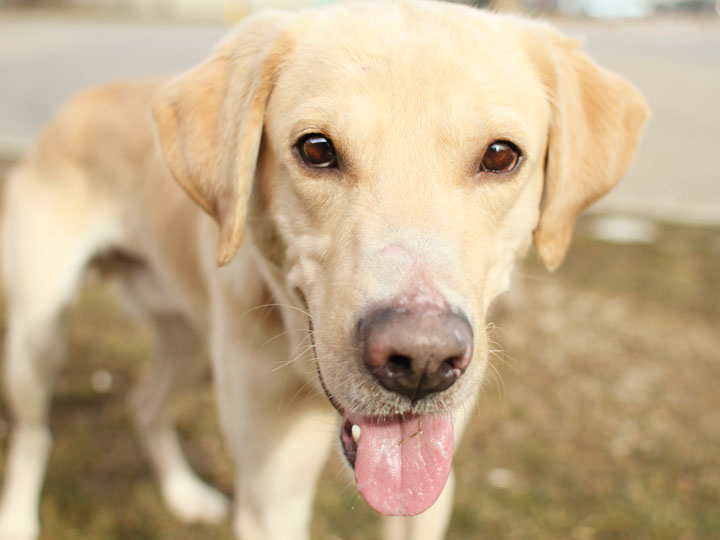
The best way to check on the adoption status of this dog (and other dogs and cats and other small domestic animals) is to visit Toronto Animal Services adoption website or call 416 338 6668 for the Toronto Animal Services South shelter.
Omigod, look what I read in the paper the other day:
Misguided parents of teenagers in the Ontario Legislature came together in support of a private member’s bill this past week that would lift a ban on such potentially deadly children. These politicians would do better addressing the public’s real problems instead of trying to reverse its protections.
All the arguments made in defence of teenagers were familiar and unconvincing. The problem is “the rage, not the age,” said the co-sponsor of the bill. She correctly noted that any child can assault a person and some younger children are even more aggressive than teenagers.
“We know that tweens are as capable of violence, or more capable of violence, as so-called teenagers,” she said. True — but where a rampaging tween is likely to steal someone’s iphone, a teenager can stab someone or run over someone with a car. Indeed, both these horrors have been perpetrated by teenagers. In these cases, the rage is the age.
Yes, the critics are right: it’s hard to define all possible teenager types. But difficulty in defining a problem is no reason not to address it. And yes, bad parents are largely to blame when teenagers go rogue. So what? Bad people are the only ones likely to use a machine gun to commit robbery. But — in the interest of public safety — we ban machine guns from all, including the good.
In fact, the province’s teenager “ban” is a misnomer. Ontarians are free to have these children, provided the teens have been neutered and kept muzzled in public. Given the danger they present, teenagers can’t be legally bred or imported into the province. That seems a reasonable compromise.
The governing Liberals are correct in defending this province’s existing teenager legislation. The law isn't perfect, but it’s right in putting public safety ahead of the concerns of parents of teenagers.
Okay, I didn't actually read that in any paper but I read something similar. Someone sent me a link to a Toronto Star piece regarding Pit Bulls entitled, Pit bulls are dangerous and Ontario is right to ban them.
If you're familiar with this blog, you already know what I think about that opinion, but I'm going to say it anyway. It's shit. Not dog shit, not horse shit, not bull shit but the worst kind of shit and that's human shit because only humans can attempt to justify and self-righteously support such prejudicial and hypocritical slaughter of innocent family pets.
To highlight the ridiculousness of the piece, I did that word replacement exercise above, replacing "Pit Bull" with "teenager" and "dogs" with "children". I've got nothing against either teens or children - in fact, I've been both, once upon a time - but the word change shines a more revealing light on the reactionary mentality of the piece.
It may be a rather juvenile exercise but no more juvenile than publishing the kind of unresearched, unnuanced, compassion bereft crud I expect from The Sun, not The Star.
So who is the anonymous Star writer of that piece? The way the writer intentionally misleads the reader into thinking Pit Bulls in Ontario only have to suffer being "neutered and kept muzzled in public" and that this "seems a reasonable compromise" completely ignores the fact that perceived Pit Bulls are also impounded, caged, and killed in this province. The writer takes after MPP David "genetalia chewed off" Zimmer in that regard when it comes to ignoring the important details.
Here's a better response to The Star's Pit Bull hating piece. It's written by Steve Barker at Chicobandito.
Dear editors:
After reading the editorial “pit bulls are dangerous” (February 26), I felt the need to respond with a little common sense combined with a few facts.
I would not normally be so quick to tell a group of experts in their field how to do their jobs, but have you forgotten the basic lessons of Journalism 101, specifically research?
If, as you put it, the deed is the breed when a pit bull attacks, then is this also the case when a retriever attacks or a German Shepherd or a husky or a sled dog or a sheepdog or a Rottweiler or a “farm dog” or a Border Collie or a number of other types of dogs? Why do I list these specific types of dogs? Because they have ALL killed children in Canada and because, in the twenty-nine years that we’ve been tracking these things, a pit bull has never done so. I repeat, at least thirty-five children have been killed in this country by at least eighty-five dogs , yet a pit bull type dog has never killed a child in Canada, ever!
As journalists, does this not make you stop, for one moment, and think that maybe, just maybe, breed is not the issue here?
In 2005, Michael Bryant, former Ontario attorney general, stood up in the Legislature and listed nine bite incidents supposedly perpetrated by pit bulls over a sixty-nine day period. He used these specific incidents as his justification for introducing the pit bull ban in the interest of public safety. NINE incidents.
According to the Canada Safety Council, as many as 33,000 people were bitten by dogs in Ontario during that same time period with as many as 5,500 requiring medical treatment and 250 of those requiring hospitalization, yet Mr. Bryant, in his zeal to drum up public support for his discriminatory law, conveniently forgot to mention these during his impassioned plea for public safety. Were all of these injuries perpetrated by pit bulls? Not according to the dog bite statistics from cities such as Windsor, London, Thunder Bay, Ottawa, Toronto, and Mississauga. In fact, it appears that pit bull type dogs were involved in incidents relatively proportionate to their population, just like other types of dogs, and they did not cause a higher percentage of hospital visits or medical attention.
Every single Canadian expert in dog aggression and dog behaviour, as well as worldwide scientists in similar fields, including the leading researchers in canine genetics, disagree with your editors’ assessments of these dogs. So, instead of simply buying into the hype and writing an undocumented, unresearched, and unproven piece of fluff in order to create controversy and sell newspapers, perhaps you should put some effort into your analysis and start asking yourselves (and then us) why every dog behaviour expert on the planet, people with far more experience in these fields than you or I, argues that you and the Ontario government are wrong.
A ban on a particular breed or type of dog is the proverbial killing of a gnat with a sledgehammer. Studies from both the United States and Canada estimate that only 0.01% of dogs cause serious injury to a human being. That leaves 99.99% of all dogs (including pit bulls) that somehow manage to live with us without turning on us when we’re not looking. It also appears that, based on the unprecedented number of reversals of bans that are happening worldwide, those types of discriminatory laws were not even preventing the 0.01%.
In the meantime, the ban in Ontario (and yes, despite your claims to the contrary, it is a ban) has caused the deaths of thousands of dogs each year, dogs whose only crime was to possibly look like some ill-defined, unprovable shape of dog that the government has managed to persuade the public (and obviously some members of the media) is dangerous. As a result of this ban, dog owners have lost their houses, their jobs, their life savings. Many dog owners, including myself, have left the province, sometimes at great sacrifice, in order to escape constant harassment and discrimination.
To give you some idea of the ridiculousness of this approach, look at these annual Canadian death statistics, courtesy of Health Canada 1996:
Tobacco: 45,000
Suicides: 3,900
Car accidents: 2,900
Alcohol: 1,900
Murders: 510
Dogs (of all breeds): ONE*
* info courtesy of Dog Legislation Council of Canada and National Canine Research Council
I, and many thousands of dog owners, would greatly appreciate it if the editors of the largest newspaper in Canada would put a little more effort into separating accuracy and facts from hype and hysteria, rather than rattling off a piece of doggy doo to fill the page and create a stir.
Sincerely,
Steve Barker (formerly of Toronto, left family and friends behind to move to BC from Ontario)
Thank you, Steve.
Update 12-02-29: There appears to be some disagreements brewing between the wiser, more experienced writers and the sliding towards mediocrity editors at The Star.
Walkom: Why Ontario’s pit-bull ban should end
Thanks to the efforts of MPPs from all three parties, Ontarians are being given a chance — a chance — to see a patently bad law buried.
That law is the province-wide ban on pit bulls, a statute enacted seven years ago on the basis of much demagoguery and virtually no evidence.
The ban’s origins were fear and opportunism.
We should all write Mr. Walkom a bunch of thank you e-mails. And maybe send some flowers. twalkom@thestar.ca
Tia looks like an Australian Kelpie which is not a dog one sees very often in Toronto because, let's face it, Australia is on the other side of the planet and that plane ride over is a killer unless you're in first class and when was the last time you saw a dog in first class?
I thought Tia might be a prankster when I first saw her but it turns out she's a bit of a shy girl and a little unsure of her situation. We walked outside for five minutes and then she got concerned we were too far from the TAS building and she started to pull to go back. She pulled me right inside the building, upstairs and to her kennel and then when she got into her kennel, she stood there for a second and realized that was no fun either so I took her back into the main hallway and sat with her for a bit, watching all the people looking at the other animals.


The best way to check on the adoption status of this dog (and other dogs and cats and other small domestic animals) is to visit Toronto Animal Services adoption website or call 416 338 6668 for the Toronto Animal Services South shelter. If the dog is no longer on the TAS adoption website, it's probably because it's been adopted already.
Worried ...

... worried ...

... worried.

Never seen a big dog look so worried.

Gomez needs some training in the you're-too-old-to-act-like-a-puppy department and he also needs some reassuring that his next home is going to be a permanent one. He's one of those dogs who will be truly amazing with the right owner or a bull in a china shop with the wrong one.

The best way to check on the adoption status of this dog (and other dogs and cats and other small domestic animals) is to visit Toronto Animal Services adoption website or call 416 338 6668 for the Toronto Animal Services South shelter. If the dog is no longer on the TAS adoption website, it's probably because it's been adopted already.
